Adelle Davis - “Thousands upon thousands of persons have studied disease. Almost no one has studied health.”
|
| Liquid Cod Liver Oil |
Cod Liver Oil: Aceite de igado de Bacalao, Acides Gras Oméga 3, Acides Gras N-3, Acides Gras Polyinsaturés, Cod Oil, Fish Liver Oil, Fish Oil, Halibut Liver Oil, Huile de Foie, Huile de Foie de Flétan, Huile de Foie de Morue, Huile de Foie de Poisson, Huile de Morue, Huile de Poisson, Liver Oil, N-3 Fatty Acids, Omega 3, Oméga 3, Omega 3 Fatty Acids, Omega-3, Omega-3 Fatty Acids, Polyunsaturated Fatty Acids.
According to Web MD, cod liver oil can be obtained from
eating fresh cod liver (not likely) or by taking supplements. As a child we got
cod liver oil bottled liquid from the fish store. It was nasty tasting regardless of using salt
and/or lemon juice.
Web MD states cod liver oil is used for high cholesterol,
high triglycerides, kidney disease in people with diabetes, high blood
pressure, heart disease, osteoarthritis, depression, an autoimmune disease
called systemic lupus erythematosus (SLE), glaucoma, and middle ear infections
(otitis media).
When taken by mouth for lowering triglycerides and blood pressure:
20 mL of cod liver oil per day. For high
cholesterol: 30 mL of cod liver oil per day.
Cod liver oil appears to help lower high triglycerides (a type of blood
fat), lower high blood pressure, and treat some symptoms of kidney disease
related to diabetes. It doesn’t seem to lower high cholesterol or reduce
arthritis pain. Other uses are still under investigation.
Cod liver oil contains certain "fatty acids" that
prevent the blood from clotting easily. These fatty acids also reduce pain and
swelling.
Side effects: Check
Web MD
 |
| Korean food-Packed kimchi |
Kimchee (Kimchi) is made from fermented vegetables, usually cabbage and/or radishes, but there are many different types of Kimchee so the taste and nutritional value can change even though all the different variations of the food are good for you. There are hundreds of varieties of kimchi made with a main vegetable ingredient such as napa cabbage, radish, scallion or cucumber. Common seasonings also include ginger, chopped radish, garlic, saeujeot (hangul: 새우젓, shrimp sauce), and aekjeot (hangul: 액젓, fish sauce).
Kimchee has been a popular food in Korea for a couple thousand years. The food is fermented and can smell pretty bad. Oddly the spicy dish taste great. It’s one of foods favored by Dr. Oz. The nutritional value of Kimchee is wonderful, a serving provides your body with a full days recommended amount of Vitamin C as well as carotene and it is also loaded with a high concentration of dietary fiber with minimal calories. Kimchi is rich in vitamin A, thiamine (B1), riboflavin (B2), calcium, and iron, and contains a number of lactic acid bacteria, among those the typical species Lactobacillus kimchii. Health magazine named kimchi in its list of top five "World's Healthiest Foods" for being rich in vitamins, aiding digestion, and even possibly reducing cancer growth.
 |
| Kohlrabi stems with leaves removed |
Kohlrabi has been
created by artificial selection for a swollen, nearly spherical shape; its
origin in nature is the same as that of cabbage, broccoli, cauliflower, kale,
collard greens, and Brussels sprouts: they are all bred from, and are the same
species as, the wild cabbage plant (Brassica oleracea). There are several varieties commonly
available, including White Vienna, Purple Vienna, Grand Duke, Gigante (also
known as "Superschmelz"), Purple Danube, and White Danube. Coloration
of the purple types is superficial: the edible parts are all pale yellow. The
leafy greens can also be eaten. Kohlrabi
can be eaten raw as well as cooked.
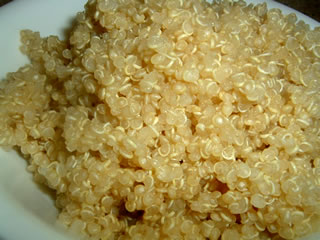 |
| Cooked Quinoa |
Quinoa is native to the Andes Mountains of Bolivia, Chile, and
Peru. This crop (pronounced KEEN-WAH), and has been eaten continuously for
5,000 years by people who live on the mountain plateaus and in the valleys of
Peru, Bolivia, Ecuador, and Chile. Quinoa
means "mother grain" in the Inca language. This crop was a staple
food of the Inca people and remains an important food crop for their
descendants, the Quechua and Aymara peoples who live in rural regions.
Quinoa
is higher in lysine than wheat, and the amino acid content of quinoa seed is
considered well-balanced for human and animal nutrition, similar to that of
casein. Quinoa grain has lower sodium content and is higher in calcium,
phosphorus, magnesium, potassium, iron, copper, manganese, and zinc than wheat,
barley, or corn. Quinoa is used to make flour, soup, breakfast cereal, and
alcohol. Most quinoa sold in the United States has been sold as whole grain
that is cooked separately as rice or in combination dishes such as pilaf.
| Noodles packaged wet |
Shirataki (shee-rah-TAH-kee) noodles are thin, low carb,
chewy, and translucent traditional Japanese noodles. They are also sometimes
called konnyaku noodles. Shirataki noodles are thinner than wheat noodles, do
not break as easily, and have a different texture. They are mostly composed of
a dietary fiber called glucomannan and contain very few calories and
carbohydrates (sometimes even zero). They do not have much flavor by
themselves, but absorb flavors well from other ingredients you can combine them
with. Shirataki noodles are made from Konjac flour, which comes from the roots
of the yam-like Konjac plant grown in Japan and China.
Glucomannan is
a water-soluble dietary fiber made from the roots of the Asian Konjac plant.
Glucomannan makes up the majority of substance in shirataki noodles. Eating
lots of dietary fiber, which is found only in plant foods (such as whole
grains, fruits, vegetables, beans, seeds and nuts) has been proven to have many
health benefits.
As an alternative to eating shirataki noodles, glucomannan
is also sold in capsule form as a dietary supplement. Some evidence suggests
that glucomannan in capsule form may help weight loss, since it absorb a lot of
water and occupies space in your stomach, which leads to a feeling of being
full.
Glucomannan capsules have been featured on Dr. Oz.
Shitake Mushrooms (Lentinula edodes) (from Japanese 椎茸, シイタケ (Shiitake)) is an edible mushroom native to East Asia. In the East, the shiitake mushroom has long been considered a delicacy as well as a medicinal mushroom. The oldest record regarding the shiitake mushroom dates back to AD 199 at the time of Emperor Chūai in Japan. However, the first written record of shiitake cultivation can be traced to Wu Sang Kwuang in China, born during the Sung Dynasty (AD 960–1127). Like all mushrooms, shiitake mushrooms can produce high amounts of vitamin D upon exposure to sunlight or UV light.
Modern research has indicated shiitake mushroom may stimulate the immune system, possess antibacterial properties, reduce platelet aggregation, and possess antiviral properties, possibly through antiviral agents known as proteinase inhibitors.
Shiitake dermatitis
Consumption of raw or slightly cooked shiitake mushrooms can cause "an erythematous, micro-papular, streaky, extremely pruriginous rash" that occurs all over the body including face and scalp, which appears about 48 hours after consumption and disappears after 10 days. This effect, caused by the (potentially therapeutic) toxin lentinan, is well-known in Asia, but can be unfamiliar to European physicians. It occurs in roughly 1 in 50 people, and thorough cooking eliminates the effect.
Citation
Modern research has indicated shiitake mushroom may stimulate the immune system, possess antibacterial properties, reduce platelet aggregation, and possess antiviral properties, possibly through antiviral agents known as proteinase inhibitors.
Shiitake dermatitis
Consumption of raw or slightly cooked shiitake mushrooms can cause "an erythematous, micro-papular, streaky, extremely pruriginous rash" that occurs all over the body including face and scalp, which appears about 48 hours after consumption and disappears after 10 days. This effect, caused by the (potentially therapeutic) toxin lentinan, is well-known in Asia, but can be unfamiliar to European physicians. It occurs in roughly 1 in 50 people, and thorough cooking eliminates the effect.
Citation
- Shen, J. et al. “An Evidence-based Perspective of Lentinus Edodes (Shiitake Mushroom) for Cancer Patients” (pp. 303-317), in: Evidence-based Anticancer Materia Medica (editor: William C. S. Cho). 2011. Springer. ISBN 978-9400705258
- Tsuji, Shizuo (1980). Japanese Cooking: A Simple Art. New York: Kodansha International/USA.
- Lindequist, U.; Niedermeyer, T.H.J. ; Jülich, W.D. (2005). "The pharmacological potential of mushrooms". Evid Based Complement Alternat Med. 2 (3): 285–99. doi:10.1093/ecam/neh107. PMC 1193547. PMID 16136207.


No comments:
Post a Comment